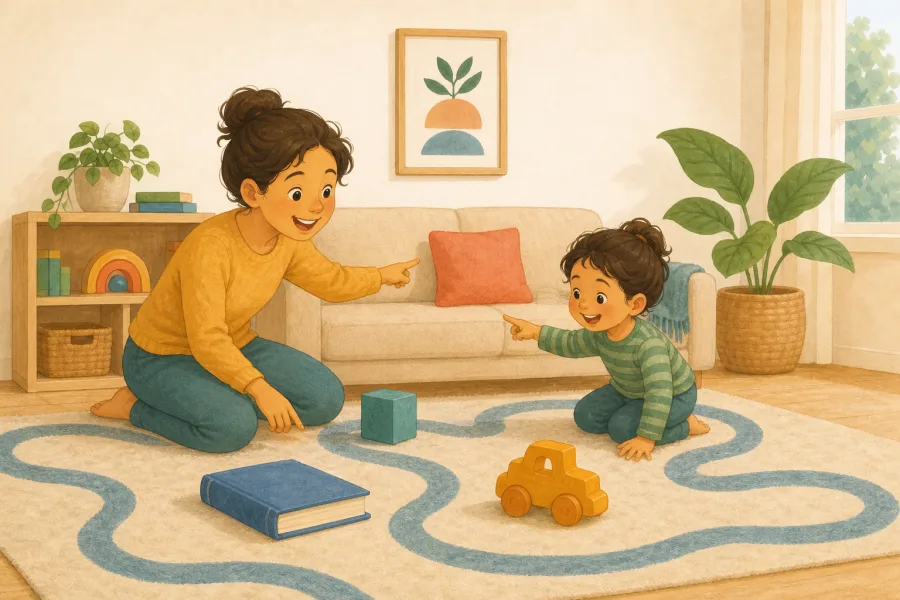
Your 4-year-old slides the tracing worksheet off the table and announces, “I’m not doing that.” Ten minutes later they’re behind a chair, running a pretend bakery and asking you what you’d like to order. That’s not a detour from learning. At 4, play is how learning happens.
The trick is to pick one game for one skill and keep it short. Ten minutes is plenty. If your child wants more, they’ll ask.
Quick answer
- At 4, most learning happens through play, not worksheets.
- Pick one game for one skill and play for about 10 minutes.
- Let your child choose the game from a short list of two or three.
- Stop while it’s still fun, not after it falls apart.
- Praise the trying, not just the right answer.
This is general information, not medical advice. If something worries you, talk to your pediatrician.
What 4-year-olds are learning
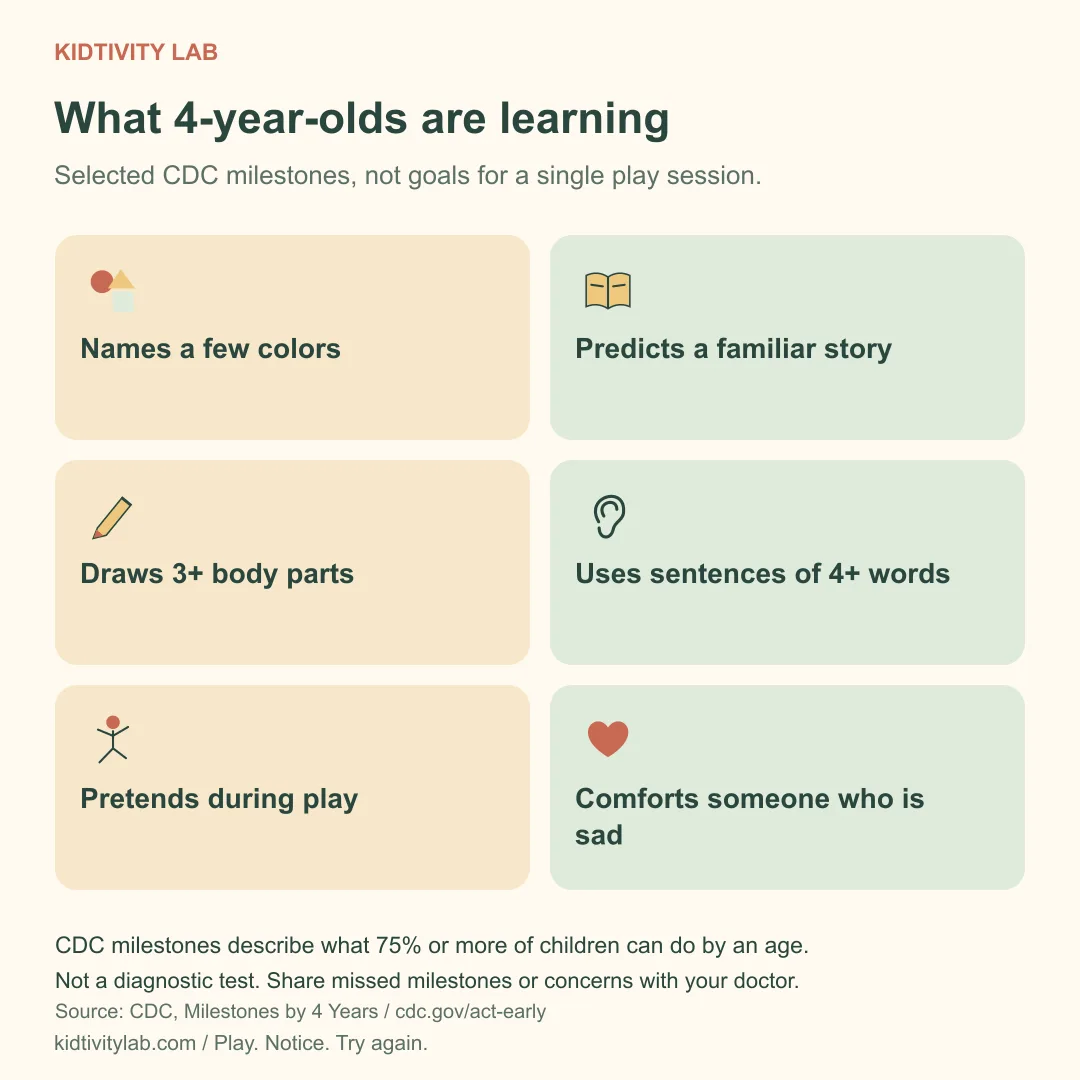
The CDC’s milestones for age 4 describe things most children (75% or more) can do by a certain age. They include naming some colors, saying what happens next in a familiar story, drawing a person with three or more body parts, and speaking in sentences of four or more words. They also include pretend play, comforting others, and liking to be a helper.
| Area | By age 4, most children… |
|---|---|
| Language | Say sentences with four or more words; answer simple questions like “What is a coat for?” |
| Thinking | Name a few colors; tell what comes next in a well-known story; draw a person with three or more body parts |
| Social | Pretend to be something else during play; comfort others who are hurt or sad; like to be a “helper” |
| Movement | Catch a large ball most of the time |
A few things to hold onto. Milestones are a checkpoint, not a scorecard. A child a few months behind on one item is often right on track, and if something nags at you, your pediatrician is the person to ask. And not every game below matches a milestone: counting and sorting are practice, since counting to 10 is an age-5 milestone.
The AAP’s Power of Play report makes the same case from the other direction: play builds executive function, the skills kids use to plan and switch gears, and helps them handle stress. So the games below are doing double duty. They practice a skill and they build the habit of playing with you.
Print the free 12-games list at the bottom of this article and stick it on the fridge. Each game has a “Tried it” box.
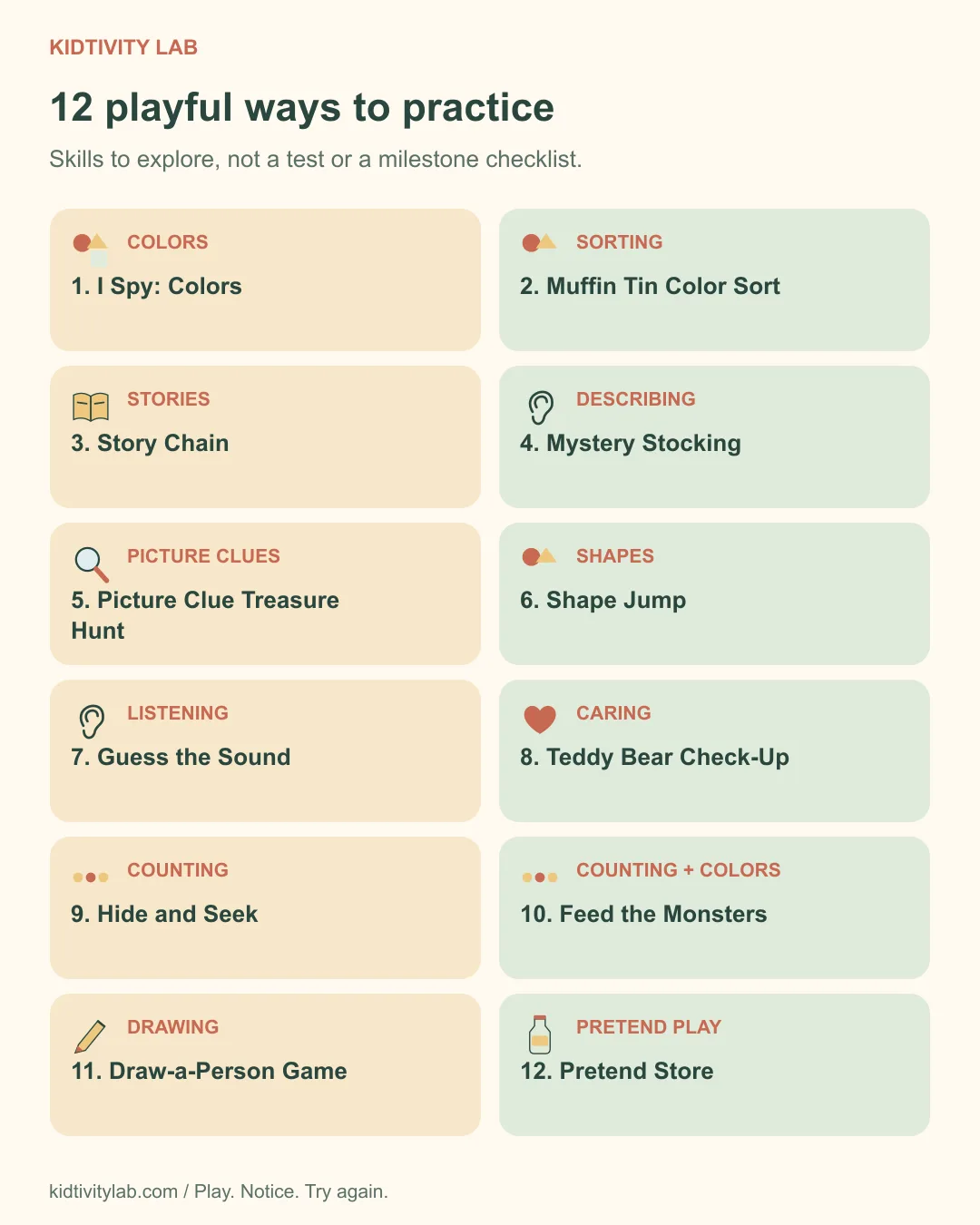
12 fun learning games for 4-year-olds
1. I Spy: Colors Edition
Ages: 2-5 · Time: 10 min · You need: nothing
Play I Spy: Colors Edition with a color instead of a letter: “I spy something red.” Your child looks around the room and guesses. Take turns so they get to be the spy too.
Make it harder: ask for two colors at once, or a color plus a shape.
2. Muffin Tin Color Sort
Ages: 18 months-4 · Time: 10 min · You need: a muffin tin, colored pom-poms or blocks
Set a muffin tin on the floor and put one colored item in each cup. Your child sorts the rest into the matching cups. Name the colors out loud as they go, without quizzing.
Make it harder: mix two shades of the same color and ask which cup they belong in.
3. Story Chain
Ages: 4-10 · Time: 10 min · You need: nothing
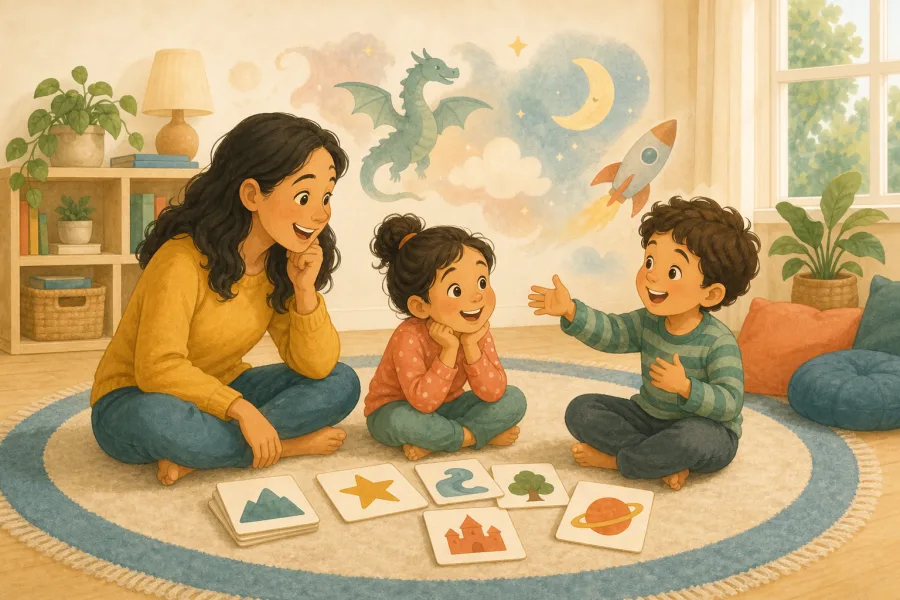
Start a story with one sentence: “A tiny dog found a giant sandwich.” Your child adds the next sentence, then you add one, and so on. Play Story Chain at the table or in the car.
Make it harder: ask “what happens next?” before your turn and wait for a full sentence.
4. Mystery Stocking
Ages: 2-7 · Time: 10 min · You need: a sock or cloth bag, small household objects
Put a few safe objects in a sock and let your child feel one without looking. Mystery Stocking works best when you ask for a describing sentence: “It’s round and smooth.” Then they pull it out to check.
Make it harder: ask for two describing words before the guess. Skip anything small enough to swallow.
5. Picture Clue Treasure Hunt
Ages: 3-9 · Time: 15 min · You need: paper, crayons, a small prize
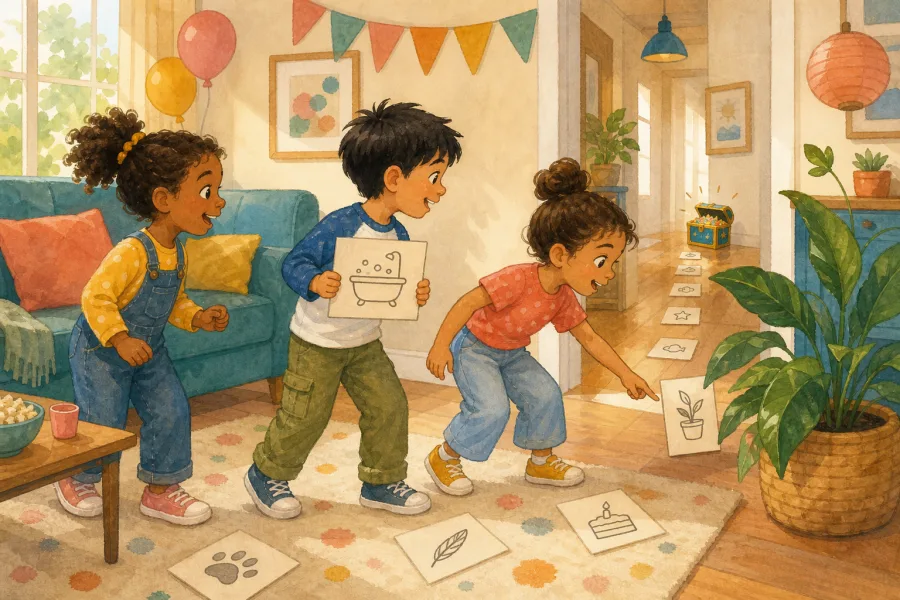
Draw simple pictures as clues and hide them around the room. Your child follows each picture to the next. Picture Clue Treasure Hunt lets a 4-year-old “read” without knowing letters yet.
Make it harder: draw a clue that shows a place, not an object, like a picture of the stairs.
6. Shape Jump
Ages: 2-6 · Time: 10 min · You need: painter’s tape
Tape a few large shapes on the floor. Call one out and your child jumps to it. Shape Jump burns off energy and practices shape names at the same time.
Make it harder: call two shapes in a row: “Circle, then triangle.”
7. Guess the Sound
Ages: 2-8 · Time: 10 min · You need: household objects that make noise
Make a sound behind your back (keys, a spoon on a cup, crinkled paper) and let your child guess. Guess the Sound is a listening game, which is quietly a pre-reading skill.
Make it harder: let your child close their eyes and make the sounds for you.
8. Teddy Bear Check-Up
Ages: 2-6 · Time: 15 min · You need: a stuffed animal, a spoon, a bandage
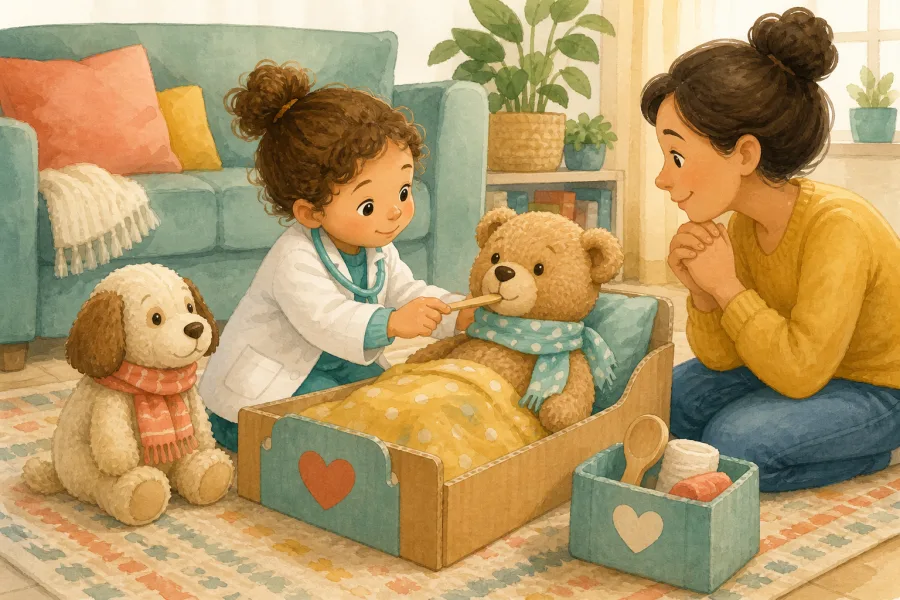
Announce that teddy has a tummy ache and needs a doctor. Your child examines, comforts, and “treats” the patient. Teddy Bear Check-Up practices two things on CDC’s age-4 list: pretend play and comforting others.
Make it harder: ask “what should we tell teddy to help him feel better?”
9. Hide and Seek
Ages: 2-10 · Time: 15 min · You need: nothing
Classic Hide and Seek gives your child a reason to practice counting to 10 out loud while you hide. Count together if they’re still learning the order. Rule out hiding in appliances, chests, or anything that latches.
Make it harder: have them count to 20, or count by twos with you.
10. Feed the Monsters
Ages: 18 months-4 · Time: 10 min · You need: paper lunch bags, colored paper, glue, crumpled paper balls in matching colors
Glue a colored paper face on each bag and cut a big mouth. Your child feeds each monster only its own color, then you open the bags and count what each one ate. Feed the Monsters turns counting and color matching into a game with a silly voice.
Make it harder: ask for “three red ones” so they combine number and color.
11. Draw-a-Person Game
Ages: 4-6 · Time: 10 min · You need: paper, crayons
Take turns adding one body part to a drawing of a person. You draw a head, they add arms, you add legs, and so on. This is direct practice for the CDC milestone of drawing a person with three or more body parts.
Make it harder: ask them to name each part as they draw it.
12. Pretend Store
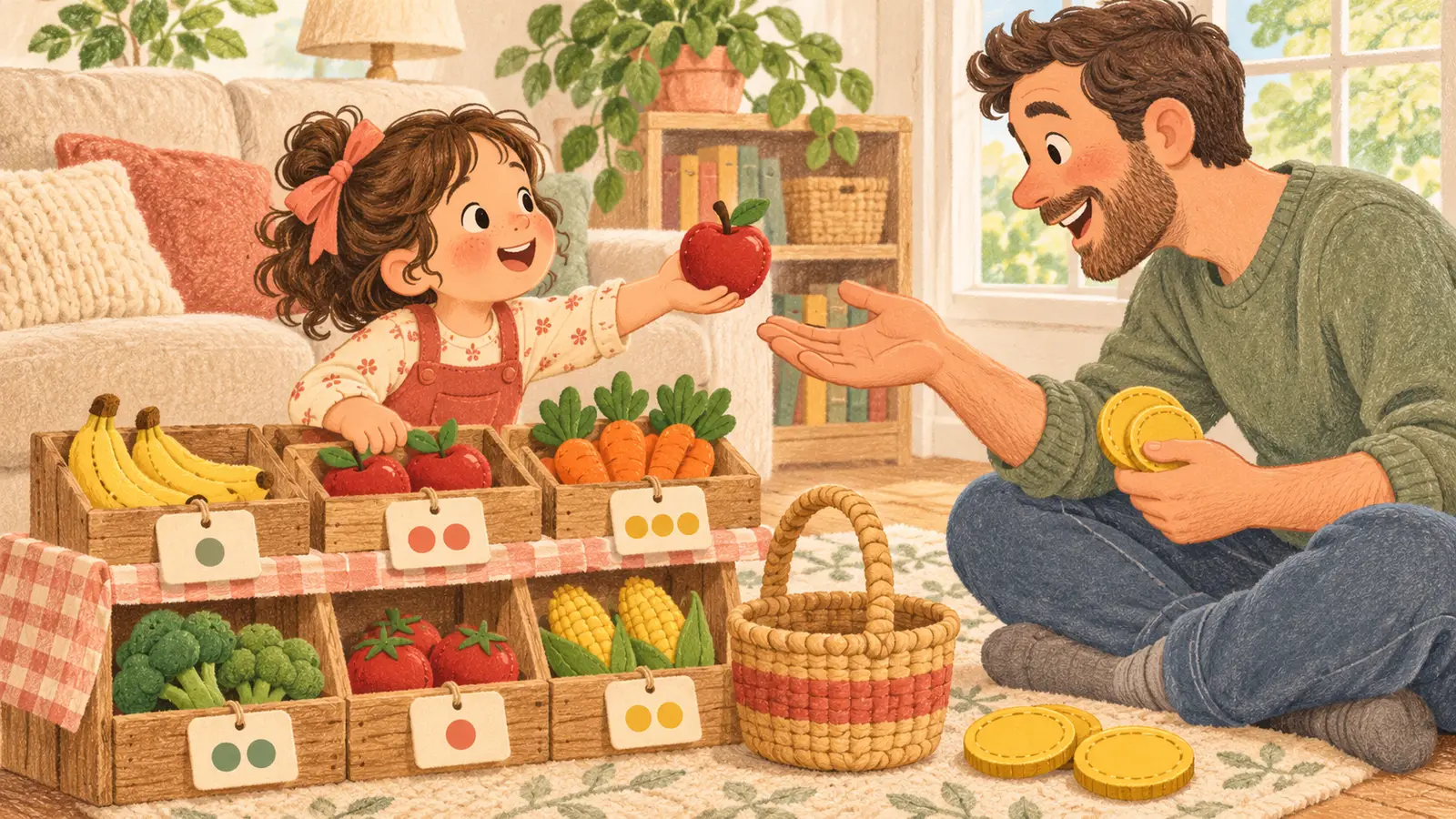
Ages: 4-6 · Time: 15 min · You need: toy food, paper price tags with dots, paper coins, a basket
Set out toy groceries with paper tags showing dots instead of numbers. Your child counts the dots and “charges” you that many paper coins. Pretend Store mixes counting practice with pretend play, which is on CDC’s age-4 list.
Make it harder: give them a budget: “You have five coins. What can you buy?”
How to keep it playful
Ten minutes is the sweet spot. Set a timer if it helps, and stop when the timer goes, even if it’s going well. Ending on a high note is what makes them ask for it again tomorrow.
Let your child pick from two or three games rather than the whole list. “Do you want the color game or the story game?” gives them control without turning the choice into a negotiation.
Praise the attempt, not the correct answer. “You kept trying different colors until you found it” teaches more than “good job.” And if a game flops, that’s information, not a failure. Put it away and try a different one next week.
Looking ahead to 5
By 5, most children can count to 10, name some letters, and pay attention for 5 to 10 minutes during activities, according to the CDC’s age-5 milestones. You don’t need to drill any of that now. When your child is ready, our learning games for ages 5 to 8 are there, but they’re not built for 4-year-olds, so save them for later. For now, keep playing.
If you want more ideas for this age, browse our activities for 4-year-olds. And if you’re curious how your child likes to learn, our guide to identifying your child’s learning style pairs well with these games, and our preschool adaptive skills checklist covers the everyday self-care side.
Common questions
What should a 4-year-old be learning?
Most 4-year-olds are learning through play: naming colors, telling what happens next in a story, drawing people with a few body parts, speaking in longer sentences, and pretending. The CDC’s age-4 milestones list these as things most children can do by this age. If your child is a few months behind on one, that’s common; talk to your pediatrician if something worries you.
How long should a 4-year-old focus on a game?
There’s no official number for age 4. CDC’s age-5 list includes paying attention for 5 to 10 minutes during activities, so that’s a generous target at 4, and shorter is fine. Attention grows with practice, and a game that ends while it’s still fun is more likely to get played again. If your child wants to keep going, follow their lead.
Are worksheets good for 4-year-olds?
Worksheets aren’t how most 4-year-olds learn best. Play-based games practice the same skills (colors, counting, stories, drawing) while also building language and social skills. A worksheet now and then won’t hurt, but it shouldn’t replace play.
What games help a 4-year-old get ready for kindergarten?
Games that practice listening, taking turns, following two-step directions, and talking in full sentences do a lot of the work. Story Chain, Guess the Sound, and Pretend Store all build those habits. So does anything that gets your child talking with you for ten minutes.