To teach kids savings goals, help them choose one affordable thing, decide where the money will come from, and count their progress together each week. A clear jar and a picture of the goal make the plan visible. Start small enough that your child can reach the finish, then let them help make the purchase.
Quick answer
- Let your child pick a specific, affordable goal.
- Show progress with a jar, picture, or printable tracker.
- Agree on a source of money that fits your family.
- Count together on the same day each week.
- Buy the item together and talk about the experience.
Your 5-year-old spots a toy at checkout. You say, “Let’s save for it,” and then everyone forgets until the next grocery trip. A useful savings plan fills in the missing parts: which toy, how much it costs, and what happens next Sunday.
Why practice saving before the amounts get bigger?
The CFPB’s guidance for young children treats ages 3–5 as a time for building foundations, even before abstract financial ideas make sense. Waiting, planning, and making small choices give you things to practice in daily life.
For school-age children ages 6–12, CFPB emphasizes habits, goals, and talking through money choices. You can model that at the store: “I’m putting this back because I’m saving for our camping trip.”
The CFPB’s research on the building blocks of financial capability also describes foundations that develop from early childhood through young adulthood. That doesn’t make age 7 a deadline or mean a child who spends birthday money has missed their chance.
You don’t need a large allowance or a perfect household budget to begin. The lesson is making one choice visible and following a manageable plan, not showing how much money your family can spare.
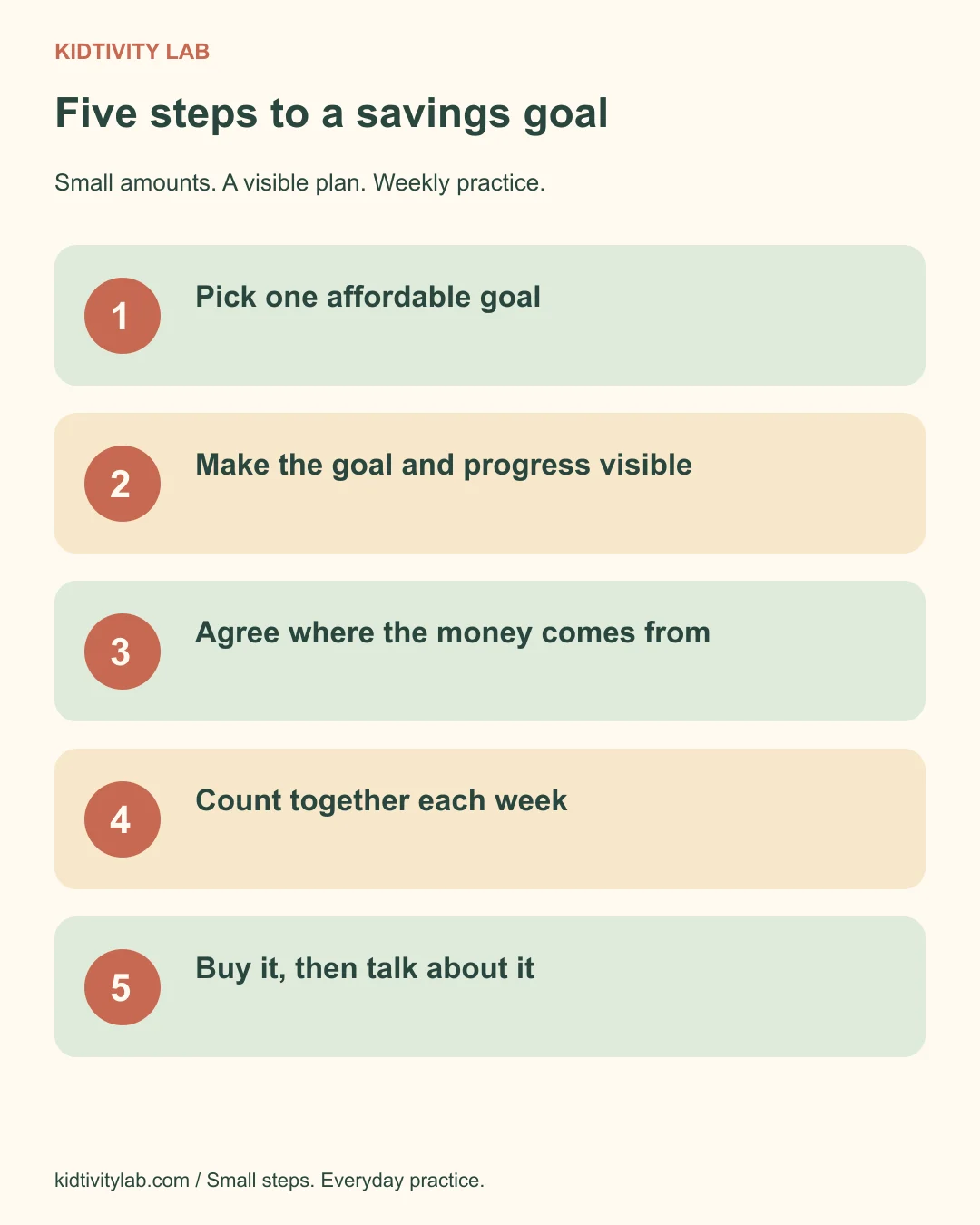
1. Let them pick a goal they can reach
Ask “What would you like to save for?” Then narrow it to a specific item and check the real price together, including any tax or shipping. “A $6 sticker book from the store” is easier to plan than “something fun.”
For a first try, aim for a goal your child can reach in two to four weeks with the money available. These are our suggested starting examples, not developmental norms or allowance rules:
| Age | Possible first goal | A manageable planning approach |
|---|---|---|
| 4–5 | A $5–$10 small toy or art supply | A short plan with a picture and adult help |
| 6–8 | A $10–$25 game, book, or craft kit | Weekly deposits and a simple count |
| 9–10 | A larger item they choose | A two-to-three-month plan if shorter goals already feel manageable |
Lower the price or lengthen the plan if those amounts don’t fit your budget. Your child can practice with $2 just as honestly as with $20.
Suppose your 6-year-old wants a $12 bike bell and already has $4. Saving $2 a week means four more weeks, assuming $12 covers the full cost. Draw four boxes and write the next four counting dates so “later” has a shape.
If the first idea would take a year, keep it as a long-term wish and choose a smaller first goal. You can say, “Let’s practice finishing one short plan before we start that big one.”
2. Make the money and the goal visible
Use a clear, sturdy container with a picture of the item attached. A plastic jar works well around young children; you don’t need a special bank or a new app.
Keep the jar in a safe place and use a paper tracker when coins aren’t suitable. Coins are choking hazards, so keep them away from children under 3 and anyone who mouths objects, and supervise counting with older children.
You can also use three containers labeled Spend, Save, Share. Explain what each means and choose amounts together, without treating one split as the correct answer for every family.
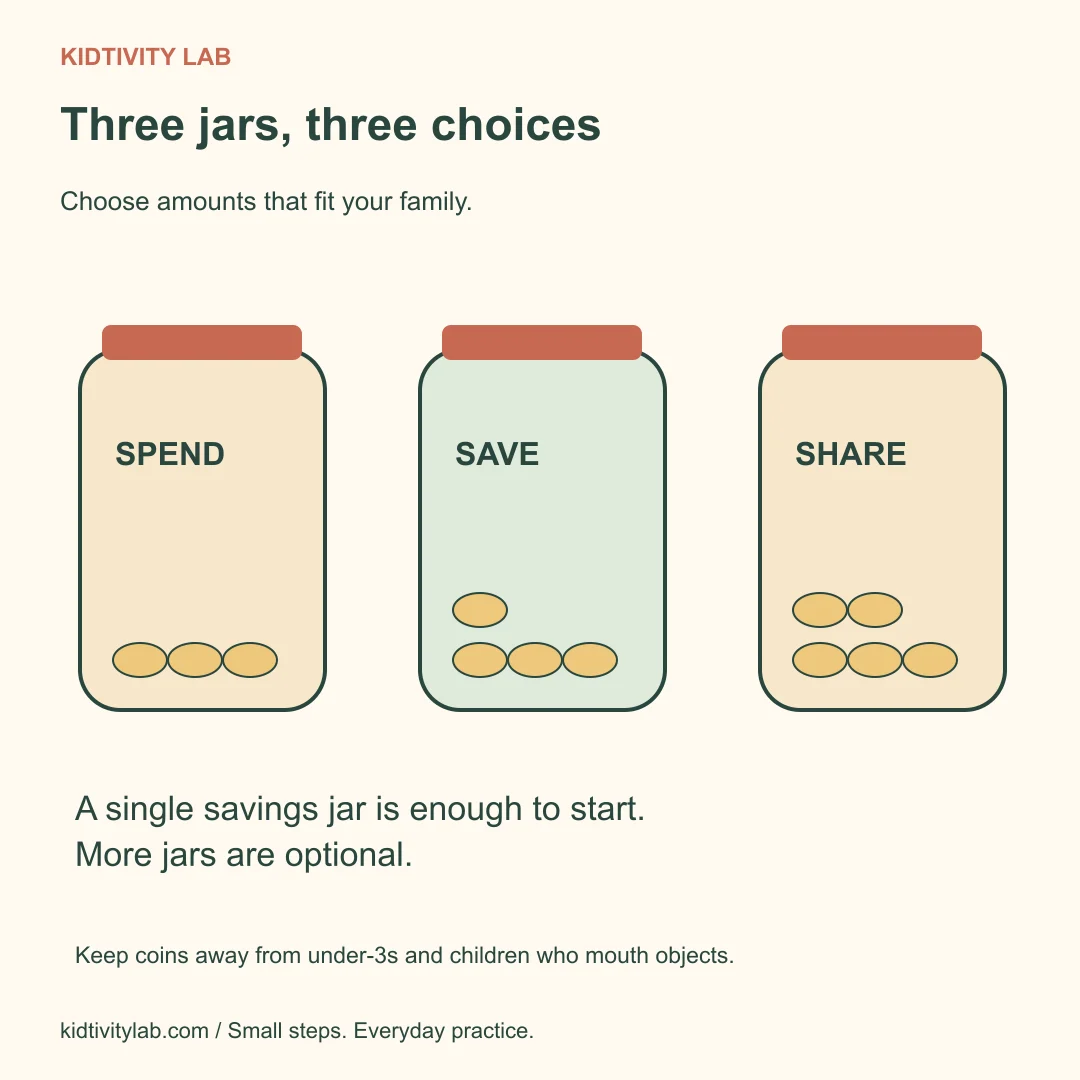
For a 4-year-old, one savings jar may be enough. Add more categories only if they help your child understand the choice rather than creating extra sorting work.
Place the free savings tracker near the picture. For a $20 goal, each of its 20 sections can mean $1; for a $10 goal, each can mean 50 cents. Write the value before coloring so the marks match the money.
3. Agree on a way for money to come in
Choose a source you can sustain: an allowance, occasional money gifts, or optional paid jobs beyond ordinary household responsibilities. The CFPB’s school-age guidance includes allowance and jobs as ways to practice earning.
Families differ about paying for chores. Some keep allowance separate because everyone helps at home; others use optional jobs to connect effort and pay. Either approach needs a clear agreement before the work starts.
Try “Putting away your own plate is part of helping here. Wiping these outdoor chairs is an extra job for $1.” Keep jobs safe and suitable for your child, and agree on what finished means.
A parent match is optional. You might add 25 cents for every $1 your child saves, up to a limit you choose. Explain it as a family bonus, not bank interest or a promise that money always grows that way.
If you match $4 saved with $1, show both amounts on the plan. Don’t offer a match you can’t maintain, and don’t make your child responsible for covering basic needs through paid jobs.
When there’s no spare money, make a pretend store with play money or plan how to use an existing gift. Practice doesn’t require a weekly payment, and you can say clearly, “We aren’t adding money this week.”
4. Count it together on the same day each week
Pick a short, predictable check-in, perhaps Sunday after breakfast. Tip the jar onto a tray, sort the coins, count the total, and color only the progress already saved.
For the bike bell example, write: “Goal $12. Saved $8. Still needed $4. At $2 each week, two more weeks.” If deposits change, update the estimate rather than presenting the original date as a promise.
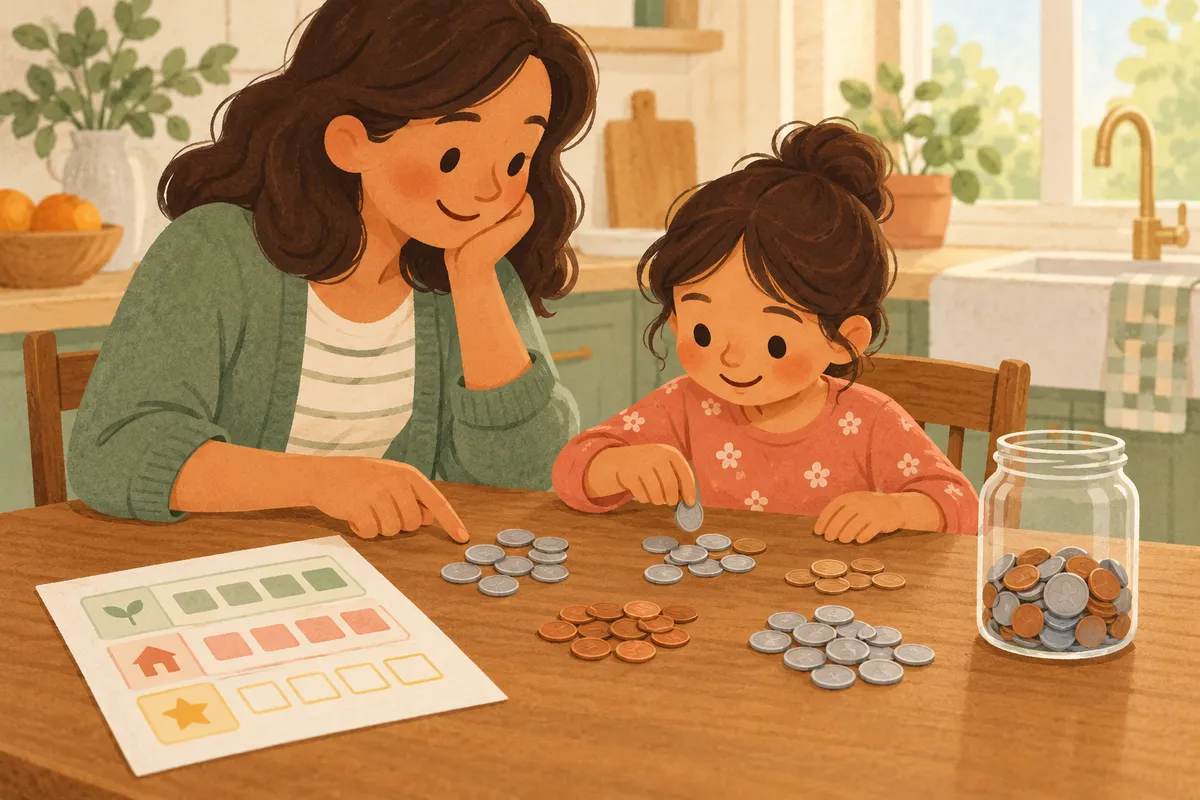
Your 7-year-old might see a big pile of pennies and think they’re almost finished. Count with them and compare values gently: “These ten pennies make ten cents. Let’s see how much the whole pile is worth.”
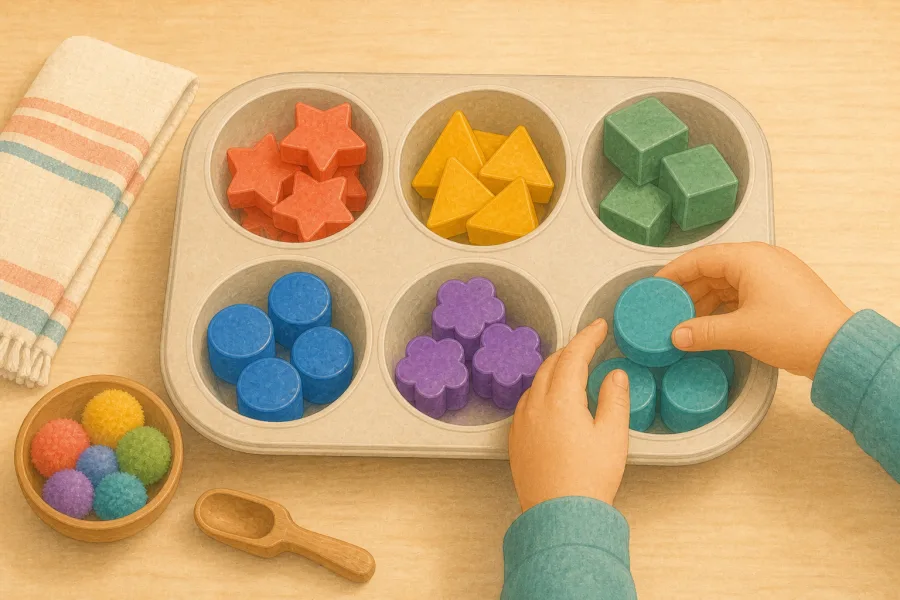
For playful sorting practice, adapt Muffin-Tin Color Sort using paper coin pictures, or real coins with appropriate supervision. For ages 5–8, explore the money activities in our learning games together.
As your child gets older, you can discuss a savings account alongside the jar. CFPB’s school-age saving ideas can help you start that conversation; compare account fees, access rules, and adult involvement before opening anything.
You can revisit a coin value on another day instead of repeating it until everyone’s tired. Our article on how children learn and remember explains that kind of spaced practice.
5. Let them make the purchase, then talk
When the goal is reached, check the current total price before leaving home. Let your child help count cash at the register or watch how you use the saved amount for an online purchase.
Say, “You planned for this and saved enough.” Keep the focus on what they did, rather than calling them a good or bad saver.
Later, ask three short questions: “Was it worth the wait?” “What was hard?” and “What would you like to do next?” They don’t need a polished answer.
If the toy disappoints your 9-year-old, listen before offering a replacement. “You thought it would be bigger” leaves room to discuss pictures, descriptions, and return options without shaming them or automatically buying another toy.
Enjoy the finish before setting the next target. It’s okay for a child to spend the goal money on the planned item; saving was the way to make that choice possible.
When saving gets hard
They want to spend everything on the way. Show the tradeoff: “You can buy that $2 snack with your spending money. If it comes from this goal, we’ll need another week.” Keep food needs separate from this optional example.
The goal changes. Let your child pause, compare the new price, and redraw the plan. Changing their mind isn’t dishonesty, and learning to reconsider a purchase is useful practice.
A relative gives them the item early. Thank the giver and help your child choose a new use for the saved money. You can quietly coordinate future gifts with relatives without making the child manage the conversation.
The plan keeps getting forgotten. Shorten it, lower the goal, or move the tracker where you’ll see it. Practicing waiting is part of everyday preschool adaptive skills, but one unfinished savings plan isn’t a test of character or development.
Print a tracker your child can fill in
The one-page savings goal tracker has room to draw the item, write its cost, choose a weekly amount, and color 20 sections. Work out the value of each section together before starting.
Keep the sheet when you finish if your child wants to see their progress. Reuse the routine for another small goal, adjusting the amount and time to fit your family.
Common questions
What age should kids start saving?
Preschoolers can practice with a picture, a small amount, and adult help. CFPB offers money activities from age 3, but that doesn’t mean a 3-year-old needs an allowance or understands a bank account.
How much allowance should a 6-year-old get?
Choose an amount your family can afford and explain what it’s for. As an example, $2 a week can support a small goal; it’s an illustration, not a recommended rate or a payment every child needs.
Should kids save half their money?
There isn’t a universal percentage for this family exercise. Agree on a split that leaves a realistic path to the goal, and discuss spending and sharing without making every gift subject to a complicated formula.
Is a piggy bank or savings account better?
A jar makes small amounts visible and easy to count, while an account offers a different way to practice with adult guidance. Choose based on your child’s understanding, the amount, and the account’s fees and rules; you can use both.