
An activity you can start today
Picture Memory Match
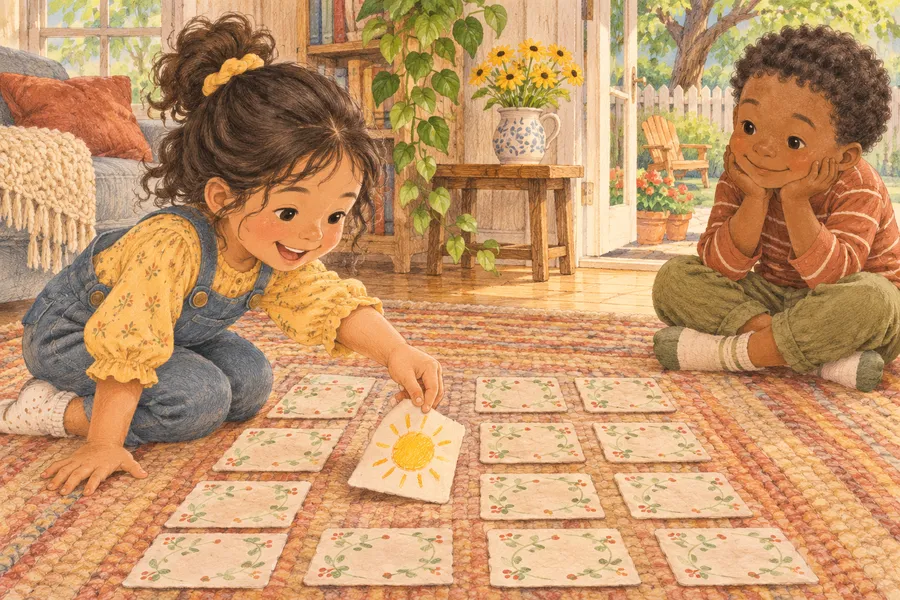
Draw matching pairs on index cards, flip them face down, and take turns hunting for two of a kind.
Know before you start
At a glance
- Setup
- 10 min
- Cleanup
- 2 min
- Mess
- low
- Energy
- calm
- Adult help
- nearby
Before you start
- Decide on 6 pairs to start. That is 12 cards, a 3 by 4 grid, which fits on most tables.
- Draw or stick one picture per card, big and bold: sun, apple, house, star, cat, tree.
- Shuffle well and lay the cards face down in neat rows so no card is hidden under another.
Step by step
Let’s play
- Make the cards. Cut 6 index cards in half to get 12 cards, then draw one simple picture on each pair: two suns, two apples, two houses. Stickers work just as well.
- Shuffle and lay out a grid. Mix the cards face down and arrange them in rows, 3 across and 4 down, so every card is visible.
- Take turns flipping two. Player one turns over two cards. If they match, they keep the pair and go again. If not, flip them back and pass the turn.
- Say the pictures out loud. Name each card as you flip it: “Sun and tree, no match.” Naming helps kids hold the pictures in mind.
- Play until the grid is empty. Count pairs at the end. Everyone wins something, and the child who found the most gets to shuffle for the next round.
- Add pairs next time. Once 6 pairs feels easy, grow the grid to 8 or 10 pairs for a longer, trickier game.
The child’s-eye view
Why kids love it
Every flip is a small surprise, and the moment two cards match is a tiny win they get to announce. Drawing the cards themselves makes the game feel like theirs before the first turn even starts.
Built into the fun
What they’re learning
Children hold the location of a card they saw a moment ago in their head, then connect it to a new card they flip later.
Waiting for a turn, flipping two cards, and handing the turn to the next player practices simple game rules and patience.
A short grid of cards gives children a clear task to focus on, with a natural stopping point when all pairs are found.
Make it fit your child
Ways to change the game
Letter to picture
Make pairs where one card shows a letter and the other shows a picture that starts with it, like B and a ball. Match them the same way.
Number to dots
Pair a numeral card with a card showing that many dots. Good for kids who are starting to count and recognize numbers.
Rhyming pairs
Draw a cat and a hat, a star and a car. Flip two cards and say both words out loud to hear whether they rhyme.
Real-life fixes
If it’s not going to plan
The child peeks or flips cards over to look
Keep it light and remind them of the rule once: two cards, then flip them back. For younger kids, allow a quick peek for the first few rounds and drop it as they get the hang of it.
The game drags and interest fades
Use fewer pairs, 4 or 5, so the game wraps up while it is still fun. You can also stop early and count the pairs found so far as the score.
Good to know
Frequently asked questions
What age can kids play memory match?
Most children enjoy a simple picture version around 3 and a half to 4, and play more confidently with rules by 5 or 6. Start with fewer pairs for younger kids.
How many pairs should we use?
Begin with 6 pairs, which is 12 cards. Once your child finds matches easily, add a pair or two at a time, up to 10 pairs for older kids.
Kidtivity Lab activity guide · Last updated
Try next
Blanket Fort Reading Den
Build a cozy den from blankets, then hide inside with books and a flashlight.
Figurine Book Match
Toy animals meet their portraits: match the plastic elephant to the elephant on the page.
Animal Yoga
Stretch like a cat, balance like a flamingo, roar like a lion — yoga disguised as a trip to the zoo.